 By admin
- Share on Facebook
- Share on Twitter
Share on Bluesky- Comments
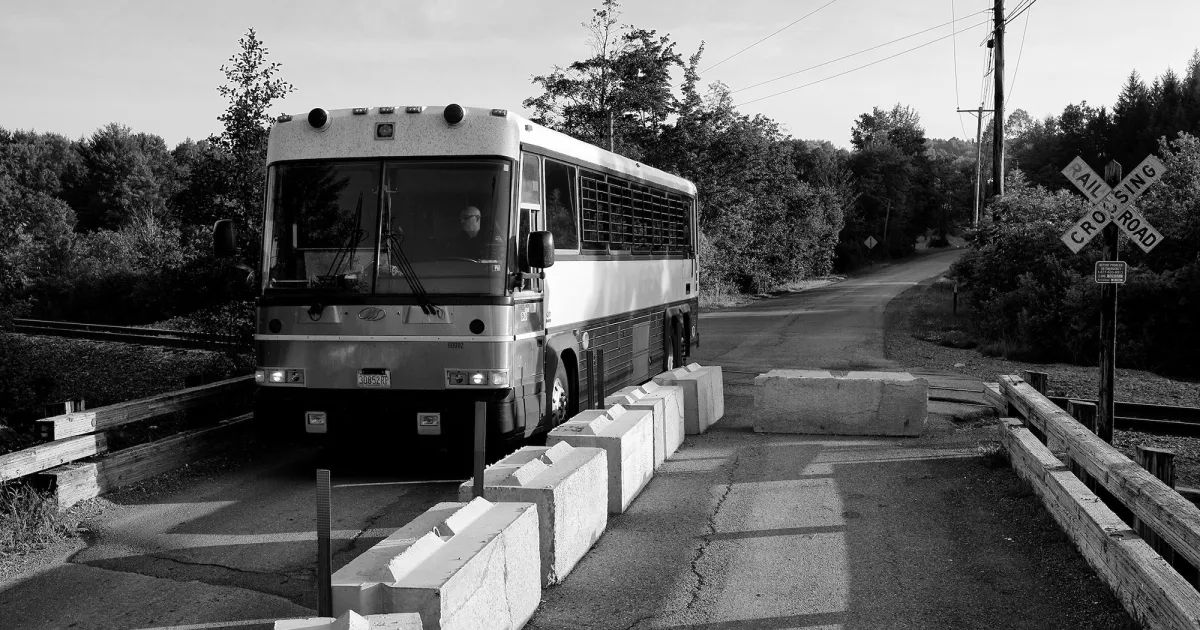
A sign is placed in the yard of a residential property off US Route 322 approaching the small town of Philipsburg in central Pennsylvania. The sign appears almost as if it is floating in the lush green grass. Greeting passersby entering this town of some 3,000 residents, it displays a weeping Statue of Liberty covering her face in shame and sorrow before Route 322 twists and curls through the heart of town.
Read more OpenAI Cancels Its Advanced Model Launch, Then Heads to Lunch With Trump
Philipsburg is a town with a history built on timber, industry, and coal. Industry has disappeared, and it’s been decades since coal was a significant employer. Yet one employer has remained in Philipsburg: GEO Group, the second largest for-profit prison company in the US.
Eager to replace lost jobs, developers from the private prison company Cornell Corrections, and the state, believed the construction of a prison would fill this need. Built on the grounds of an old strip mine, Moshannon Valley Correctional Facility opened in 2006 and operated as a federal prison for fifteen years. Cornell was acquired by GEO Group in 2010, and in 2021, the prison temporarily closed only to reopen later that same year as an immigration detention center. ICE signed a 5-year agreement with Clearfield County. Clearfield County then signed a “management agreement” with the owner and operator of the prison, GEO Group. The prison was renamed the Moshannon Valley Processing Center (MVPC).
Buried away and completely hidden out of sight in a dense forest, more than 1,600 immigrants are imprisoned there on any given day in what is the largest immigration detention center in the northeast. Eighty-five percent of those detained in MVPC have no criminal record. In 2025, two immigrants died in ICE custody in MVPC, including 32-year-old Chaofeng Ge, found hanging by his neck in a shower stall on August 5.
In April, dozens of detainees launched a hunger strike to protest conditions. While anti-ICE and anti-detention advocates have sustained an active campaign to shut down the facility, many Philipsburg residents and local officials see things differently. An annual $200,000 administrative fee to Clearfield County for serving as the middleman in this pass-through of federal funds is one reason for keeping it open. The benefits of local tax revenue and jobs remain the other.
“I have no problem with the facility,” a local resident told me at a Knights of Columbus pancake breakfast one Sunday morning. “When jobs are lost, that place provides something for people here. If they don’t put immigrants here, they’ll find somewhere else. Keep the jobs here. I don’t have an issue with it.”
Outside its major urban centers—Philadelphia, Pittsburgh, Allentown, and the capital, Harrisburg—as well as the town of State College in Center County, home to Pennsylvania State University, Pennsylvania voters helped return Trump to office. Despite Democratic control of the governor’s office and House, rural counties have driven Pennsylvania to rank fifth nationally in 287(g) agreements, which allow local law enforcement to help carry out some ICE duties. Currently, 130 township and borough police departments, county and district attorney’s offices, constables and sheriffs statewide assist ICE. In 2026, nearly 5,500 immigrants have been arrested and detained in Pennsylvania. None of the state’s eight ICE detention facilities compare in size and function to MVPC. It incarcerates locals and out-of-state transfers in a system structured to sever and isolate immigrants from family, community, legal counsel, and due process. Moshannon has become a vital instrument in Trump’s mass deportation—rather, mass detention—machine.
Read more How Corporate Influencers Facilitated Trump’s Assault on Climate Research
It’s also a valuable piece of GEO Group’s “secure services” portfolio. Invoices obtained through open records requests show that from January 2025 to May of this year, GEO earned nearly $90 million in revenue from MVPC. As ICE retreats from using warehouses to expand detention capacity, it has spent more than $2.2 billion to directly purchase existing detention facilities from GEO Group’s competitor, CoreCivic. During a Q2 earnings call, GEO Group CEO George Zoley reported that the company was in an “active process” for the sale of several turn-key facilities. In late August, ICE published a solicitation to award contracts for “turn-key detention facilities” in four regions in the US, including central Pennsylvania. In early September, with the contract for MVPC set to expire at the end of the month, DHS requested a 6-month extension. Two weeks later, Clearfield County Commissioner approved the extension in a 2-1 vote.
Activists like Timothy Smith, who chairs the Bill of Rights Defense Committee-Keystone State, anticipate based on these moves that DHS is either preparing to contract directly with GEO Group or outright purchase MVPC.
“This will give DHS and GEO more long-term stability and release both from the local risks and oversight that have strained the operation of MVPC. I truly think it will be an outright purchase,” Smith says. Both situations would enrich GEO Group shareholders while landing a financial blow to Clearfield County and Philipsburg. In both scenarios, immigrants and the pain, trauma, grief and loss experienced by their families—including US citizens—are both the raw materials and byproducts of profit-making maneuvers.
A mother sells everything and relocates to Maryland so she and her son can be closer to her husband. He’s languished in MVPC now for over 500 days. A father and his 18-year-old son, detained together during a routine check-in with ICE, put the pieces of their lives back together. ICE separated them. The father remained detained in Philadelphia. The teenager was transferred to MVPC. A woman in New York City struggles to find legal strategies to stop the deportation of her husband to eastern Europe. As we talk, he’s now in his eighth day in MVPC’s solitary confinement unit. A man sits alone in his studio apartment outside of Pittsburgh and confronts the “empty space” in his life. Faced with the reality of spending more months detained in Moshannon, his husband made the decision to self-deport.
Charlotte
Charlotte’s husband has been detained in Moshannon Valley Processing Center for over one and a half years. She was born in California; her husband is from Afghanistan and arrived in the US in 2016 on a valid student visa. They met in 2019, had a child together and got married in 2021. They lived in Illinois, where he received a REAL ID driver’s license and a work permit valid until 2029. In early 2025, while visiting family in Maryland, he was pulled over by a sheriff in West Virginia. No reason was provided for his arrest. He was transferred to ICE detention at Moshannon Valley Processing Center. To be closer to her husband in detention, Charlotte sold everything and moved to Maryland.
“I’m a US citizen and I have a child. They want us to be left with nothing. So then do we give up? But at this point, we can’t give up. Because they won’t even let him self-deport. They won’t let him sign voluntary departure. They won’t let him do anything.”
Read more Rob Sand Says He Isn’t Trying to Turn Iowa Blue. It Just Might Happen Anyway.