 By admin
- Share on Facebook
- Share on Twitter
- Share on Bluesky
- Comments
Twelve days before the midterm elections, New Jersey Senator Cory Booker and former Montana Senator Jon Tester traveled down to Alabama to campaign in one of the country’s most unexpected battleground districts. They trekked to Dothan, Alabama, the “peanut capital of the world,” which sits in Houston County, where Donald Trump won 73 percent of the vote in 2024. It’s now part of the state’s second congressional district, which Republicans redrew to oust first-term Democratic Rep. Shomari Figures after the Supreme Court dismantled the Voting Rights Act this spring.
Read more Why Nevada Republican Mark Amodei Refuses to Vote for His GOP Replacement
In 2024, Figures’ election marked the first time that Alabama had two Black members of Congress. But following the Louisiana v. Callais decision Republicans removed Figures’ hometown of Mobile, along with several Black Belt counties, from the district and added the overwhelmingly white and rural Wiregrass region in the Southeast part of the state, which includes Houston County, to dilute Black voting power and turn the seat red.
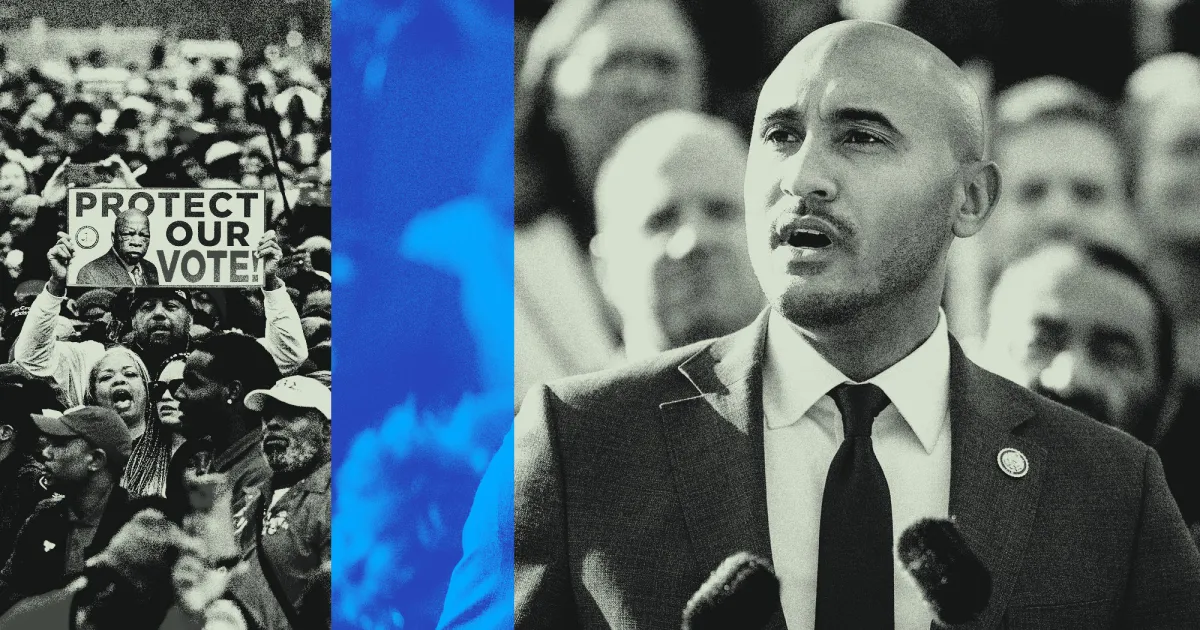
But things haven’t gone according to plan. On a Thursday at noon, a standing-room only crowd of 400 to 500 people packed a former industrial building downtown to rally for Figures. “Oh man,” Figures said when he took the stage. “When’s the last time y’all been to a rally like this in Dothan?”
“Never!” yelled members of the crowd.
“When they gave me the Wiregrass,” Figures said, “they did not know that the Wiregrass looked like this.”
Democratic candidates rarely campaign in a place like Dothan and the rally felt more like a church revival service than your typical weekday campaign event. Tester led the room in a loud “Shomari! Figures!” chant and chest-pumped Booker when he took the stage. Booker joked that Figures, who like the New Jersey senator is bald but 16 years younger, was his “stunt double.”
Figures, 41, is young and energetic, with four kids under eight. His wife, whom he met when they both worked in the Obama White House, sat in the front row with their three-year-old daughter and one-year-old son, next to his mom, Vivian, a state senator who plays the dual role of grandma and political consigliere on the campaign trail. Figures recounted how Republicans had aggressively targeted his seat. “They took a pen, they carved it up,” he said. “They carved out some communities of people who look like me. Tried to carve in more communities of people who don’t look like me. Then they said, we did it because of politics.”
The predominantly Black crowd laughed and jeered. “But what they did not know in doing that, it doesn’t matter what your district lines look like when people are paying $4 a gallon for gas,” Figures continued. “It doesn’t matter what your district lines look like when farmers are paying all-time high prices for diesel fuel. It doesn’t matter how many farmers you put into the district when those farmers are paying all-time high prices for fertilizer because a president wants to start a war in Iran.”
Afterward, locals said it was the largest Democratic event they’d seen in the area in decades. “I was born and raised in Dothan, Alabama,” says Letitia Daniels-Jackson, a community organizer who is running to become the first Black woman on the Houston County Commission. “I have never seen a rally with this much excitement and this kind of crowd, ever. This was historic for Dothan, Alabama. This has fired people up.”
Both sides agree that what was expected to be a safe Republican pickup is now essentially a coin flip. Figures is counting on anger over the Callais ruling to drive Democrats, particularly Black voters, to the polls, even in deep red areas like Dothan, while frustration over the rising cost of everything will keep traditionally Republican voters home. “We’re seeing and feeling on the ground that people are upset and the data supports that,” Figures told me in an interview before the rally.
The Supreme Court’s gutting of the Voting Rights Act was supposed to turbocharge Republican redistricting efforts—and it still might in the long-term—but in the short-term it is fueling increased turnout from Black voters, much like the Supreme Court’s decision overturning Roe v. Wade motivated women voters during the last midterm election. The pollster Terrence Woodbury calls it a “Blacklash.”
When Alabama held its congressional primaries weeks after the Callais decision, turnout increased by 10 points in Montgomery—the district’s Democratic stronghold and Figures’ new hometown—compared to 2022 and was 7 points higher than the statewide average. Alabama doesn’t have early voting, so we’ll have to wait until November 3 to see the ultimate impact of a potential backlash to the Callais decision, but Black turnout has surged during early voting in other Southern states that have recently redrawn their maps or threatened to.
The biggest increase has been in Louisiana, where the Callais case originated and where the Black share of the early vote jumped by nine points compared to 2024. Elsewhere in the South, Black turnout has increased by eight points in South Carolina, six points in Georgia, three points in North Carolina, and 2.5 points in Tennessee, according to data compiled by Tom Bonier, a senior adviser with the Democratic data firm TargetSmart. That continues a trend from the primaries, when turnout in majority-Black counties increased by nearly six points in Southern states that held primaries after the Callais decision, compared to a 1.1 point increase in states that held primaries before, found VoteHub.
“Looking at the data in these in Southern states we’re seeing very large increases in Black voter turnout,” says Bonier. Black turnout has risen in 80 percent of counties nationwide compared to the last midterm election, with the largest increases in Southern states including Louisiana and South Carolina, fueled by “very substantial increases among voters under the age of 30,” he says.
Under pressure from Trump, Republicans redrew 15 seats over the last two years in a shameless bid to retain the House. Only five of them, however, are rated solid or likely Republican by the Cook Political Report. Larry Sabato’s Crystal Ball, a project of the Center for Politics at the University of Virginia, recently moved Figures’ race to a toss-up, while Cook shifted it from from likely Republican to lean Republican, providing more evidence of its unexpected competitiveness. Trump’s signature plan to keep the House in GOP hands may ultimately end up helping Democrats more.
“The attempt to just grab and hold and retain power,” Figures told me, “is something that people here in America fundamentally disagree with.”
After the event in Dothan, Figures traveled two hours north up highway 231 for another standing-room only rally in Montgomery, where he moved after Republicans redrew his district this summer. He needs a huge turnout in his adopted hometown to win reelection.
“It’s crazy when you tell a product of the civil rights movement that Mobile is your home base,” he told a crowd of roughly 300 people who had gathered at an old water works building restored by the Equal Justice Initiative (EJI), the nonprofit organization founded by lawyer Bryan Stevenson. “Because if you are a product of the civil rights movement, whether you are in Mobile, Alabama, or New Jersey, Montgomery is your home.”
The fight for voting rights is uniquely resonant in Alabama’s capital city, home to the bus boycott, Freedom Rides, and the Selma-to-Montgomery march. “Montgomery is the birthplace of the civil rights movement,” Figures told me. “It had historically been divided, most recently into three different congressional districts. It remains whole in this district, and though many of the people who participated in the march have passed on, there’s certainly some that are still here. But more importantly, that legacy, that spirit, still resonates in Montgomery, and people know how important it is to show up.”
Blocks away, EJI built a park with statues of Martin Luther King Jr., John Lewis, and Rosa Parks to honor the city’s civil rights activism. This history is personal to Figures—and one reason he’s well-positioned to capitalize on a backlash to the Callais decision.
His dad, Michael, was born in the Jim Crow South in 1947, in a historically Black neighborhood of Mobile called The Bottom. He went on to become one of the first Black graduates of the University of Alabama School of Law and founded a law firm that filed groundbreaking civil rights lawsuits. In the 1980s, he won a civil suit that bankrupted the United Klans of America after two members of the white supremacist organization lynched a 19-year-old Black kid, Michael Donald, in Mobile. Donald is memorialized by EJI as the last person ever lynched by the Klan.
Michael Figures became the first Black state senator from Mobile in 1978 and was elected as the first Black president pro tempore of the state senate by his colleagues. When he passed away unexpectedly in 1996, his wife, Vivian, took his seat, becoming the first Black woman to represent Mobile in the state senate.
Politics and civil rights are central to Figures’ life story. Like his father, he graduated from University of Alabama Law School, then served in the Obama White House, most notably as a liaison to Attorney General Loretta Lynch, before joining the Biden administration, where he became deputy chief of staff and counselor to Merrick Garland.
In 2024, he won election to the US House after voting rights groups successfully sued to create a second majority-Black district in Alabama. That decision was affirmed by the Supreme Court in the 2023 . When the Alabama legislature refused a court order to draw “two districts in which Black voters either comprise a voting-age majority or something quite close to it,” a federal court panel with two Trump-appointed judges ordered a special master to create a new map.
But following the Callais decision in late April, in which the Supreme Court struck down the creation of a second majority-Black district in Louisiana, the justices sent the Alabama case back to the federal court panel to re-examine the evidence. The same panel again found Alabama Republicans had intentionally discriminated against Black voters. “Our previous review of the undisputed evidence left us in no doubt that Alabama’s legislatively enacted plan…intentionally discriminated based on race in violation of the Constitution,” they wrote. “Our re-examination in light of Callais yields the same conclusion.”
But this time the Supreme Court sided with Alabama and functionally reversed the Milligan ruling in June 2026, allowing Alabama Republicans to immediately put in place a new map that reduced the Black voting age population in Figures’ district from 48 percent to 40 percent, creating a new seat that Trump would have carried by 14 points in 2024. “The Supreme Court has now confirmed that there is no longer a Voting Rights Act in America,” Figures said after the decision.
Read more Anthropic’s Founders Pledged to Donate Most of Their Stock. Their IPO Tells Another Story.
Without the protection of the VRA, Montgomery is once again at the center of a new voting rights struggle. Three weeks after the Callais decision, five thousand activists rallied at the Alabama state capitol to protest the ruling. Days later, the city saw record turnout for a primary election. “Callais did not create Black political engagement,” says Anneshia Hardy, executive director of the Montgomery-based pro-democracy group Alabama Values. “What it did was definitely accelerate the pace at which we were moving.”
That energy has carried over to the general election. For the first time in 20 years, Democratic candidates are running for all seven statewide offices in Alabama. Former US Senator Doug Jones, who upset Roy Moore in 2017, is running for governor, which is expected to help Figures. “We are seeing an excitement around this state that we have not seen in many, many years,” Figures said in Montgomery.
Still, Figures must overcome a deeply rooted history of racially polarized voting in Alabama. There’s scant evidence in the state of a Black candidate ever winning in a district that is nearly 60 percent white. No Black Alabamian has won statewide office since 1994. Thirty-two of 33 Black members of the legislature represent majority-Black districts.
Alabama also ranks in voter turnout and has some of the country’s most restrictive voting laws, which makes it harder to get new voters to the polls. It has no early voting and voters must have an approved reason to get a mail-in ballot, such as being out of town or having a physical disability.
Figures points out that his original district was 48 percent Black, yet he won nearly 55 percent of the vote in 2024. His new district, though 40 percent Black, still has the largest Black share of the population of any battleground seat in the country.
“At the end of the day, campaigns are about getting out and letting people meet you,” Figures says, “breaking down those walls of presumptions and assumptions that people have about you because you are Black, because you are a Democrat, because you are from a certain place, because your background may be one thing or another.”
Figures has had just months to crisscross the new areas of his district, many of them overwhelmingly red, like the Wiregrass. He does, however, have the advantage of incumbency and has outraised his Republican opponent, state Rep. Rhett Marques. Figures and allied groups have blanketed the airwaves with ads; when I got into an Uber from the airport, I immediately heard a radio ad criticizing Marques for not supporting rural hospitals, followed by another ad hitting Marques for supporting cuts to Medicare and having “voted repeatedly to silence Black Alabamians by making it harder to vote.” When I turned on the local news at my hotel, there was another barrage of ads spotlighting Figures’ family background and slamming Marques for voting to raise taxes 22 times, including raising the gas tax by 67 percent (the ad may trigger parents who are exhausted by any mention of the phrase “6-7.”)
Republicans, for their part, are rerunning the 2024 playbook against Figures, with Trump claiming that the Democrat supports “Men playing in Women’s Sports, and Transgender for Everybody.” The president held a campaign rally in Mobile in early October, partly to shore up support for Marques, although it curiously took place in a city that is no longer part of the second congressional district.
The extent of the backlash to the Callais decision is the wild card in the race. Cornell Belcher, a longtime pollster for Obama, released a survey shortly after the Callais decision showing that Black voters viewed the Supreme Court as the biggest threat to their community, ahead of Trump and the economy/jobs. Nearly 80 percent of respondents said that the Callais decision had made them much more likely to vote. “This Supreme Court decision is an encapsulation,” says Belcher. “The Black community feels that there is an existential threat to their community and it’s not simply about gas prices and the price of eggs.”
Belcher released another poll of Black women last month and found that the anger had not dissipated. A staggering 87 percent said they were more motivated to vote because of the Callais decision.
“It wasn’t just a blip at that moment, like two to three weeks after the decision,” says Belcher. “It is still very much front and center for African American voters.”
He calls the Callais decision “a uniquely mobilizing issue,” but worries that “we’re not meeting voters where they are on their angst here.” He says that Democratic candidates and allied Super PACs, in their desire to make the election all about affordability, may be overlooking the issue that is most resonant with Black community.
Cliff Albright, a co-founder of Black Voters Matter, agrees. “The economic one seems like something that everybody agrees on, so it’s safe,” he says. “If I talk about voting rights, I may scare off some of the white folks who like my economic message, but they don’t want to hear about how oppressed Black people are.”
However, for many Black voters, the two issues can’t be separated. “Because for us civil rights and voting rights issues are economic issues,” Albright says. “Whether or not we have the right to vote impacts the money that our communities receive, the way that resources are used, our jobs.”
Figures represents some of the poorest areas in the country and argues that’s why having two Black members of Congress from Alabama is so important. “Opportunities are not abound in many places that we represent,” he says, “and so having people in those positions that can relate to those communities, whose families come from those communities, it makes us a better overall group of representatives for the state.”
There’s evidence that, even in Alabama, voters are seeing a connection between a rigged political system and a broken economic system. And it’s not exclusive to Black voters.
After a long day of campaigning in Dothan and Montgomery, Figures finished the night with a “BBQ, beats, and boiled peanuts” rally in Enterprise, the hometown of his GOP opponent, which is part of a Wiregrass county that Trump won by 57 points in 2024. Brian Peterson, a retired Black Hawk pilot and self-described “Reagan Republican,” showed up at the rally with two other ex-military friends to support Figures. He cited the “unfortunate redrawing of district lines against him” as a reason he was voting for Figures, despite still being a registered Republican. “I feel like he’s a better representation of all of the community versus a select few,” Peterson said.
Even if Figures wins reelection, his district will likely be redrawn again after the election. Prominent Alabama Republicans, including Attorney General Steve Marshall, have called for a 7-0 map that would leave the state with no Democratic or Black representatives. Other Southern states are similarly likely to push for all-white, all-Republican delegations in the coming years. But a victory by Figures in a district that was designed to defeat him could make them think twice or at least send a message that, even without a legal or legislative solution, egregious attempts at partisan and racial gerrymandering can still be defeated.
“This midterm election you’re going to see people come out in droves because they see democracy has become fragile,” says Hardy. “People are like, we have nothing else to lose but our chains. We must go vote.”