 By admin
His name might not be on the ballot this November, but New York City Mayor Zohran Mamdani is undoubtedly one of the most influential figures in American politics right now. After his barrier-breaking victory late last year, Mamdani has emerged as the face of the no-holds-barred progressive movement and has spent the season leveraging his rising capital to shape races with a string of endorsements.
Read more How “One of the Most Costliest Blunders Anyone’s Ever Made” Helped Put a Republican Seat in Play
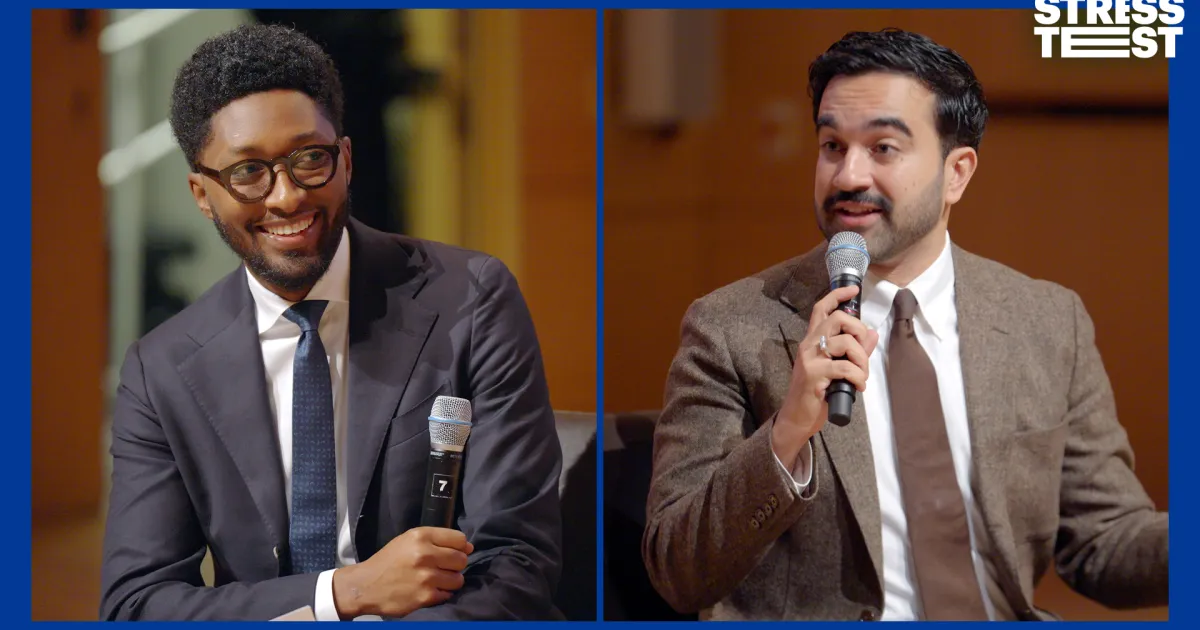
In this episode of Stress Test, co-host Garrison Hayes sits down one-on-one with Mayor Mamdani in front of a live audience at The New School’s Tishman Auditorium during Climate Week NYC—for an event co-presented by Mother Jones, Capital B, and the Bulletin of the Atomic Scientists.
With the midterms looming, Mamdani dives into an issue rapidly redefining the political landscape: the nationwide AI data center building boom. He breaks down why the surging demand for energy and resources it creates isn’t just a tech story but an urgent, kitchen-table climate issue motivating voters across party lines. And, naturally, any chat with Mamdani manages to find its way to New York’s basketball heroes, the Knicks.
But with an unexpected, headline-grabbing guest visiting Gracie Mansion just days before the event, there was only one place Garrison could start: Why does Donald Trump like him so much?
“The conversations that we have are not just those of a mayor and a president,” the mayor said after quelling laughter from the audience, “but also of two New Yorkers—two New Yorkers who have many differences of opinion, but two New Yorkers who also do love this city.”
“As long as someone can help the city, I’ll talk to him,” he added.
Climate change has been an almost daily stressor, the mayor told the audience. “We’ve been in office for close to ten months. And in that time, one out of three days, we have been in a flash flood emergency. One out of three days. And that is staggering to me, because it is a distillation of the fact that the climate crisis is fundamentally changing our day-to-day realities.”
Mamdani sees a sea change in climate messaging that can connect with the voting public. “For too long it has felt like the way that climate is treated in public discourse is almost as if it’s a concern that some can afford to have, while others have to deal with more immediate crises,” he told Garrison, pointing to real-world impacts like rising insurance rates and aging flood infrastructure. “This is not a luxury concern.”
In particular, Mamdani sees hope in the way data centers have galvanized local resistance across the country. “I think there are a lot of people who care about data centers who might not even understand that care is a climate concern,” he explained. “When you look at data centers and you look at the opposition to it, it goes beyond one party. It is one of the most bipartisan issues in this country right now. And that also shows that that, too, could be the coalition against the climate crisis.”
We’ll be back with another episode of our midterm pop-up podcast next week. Subscribe so you don’t miss a show: youtube.com/motherjones.
This transcript was generated with automated tools and may contain errors.
Garrison Hayes: Hey, it’s Garrison Hayes, co-host of Stress Test here at Mother Jones, and today on the show, a giant name in American politics right now. He might not be on the ballot on November 3, but he’s already had an outsized impact on the names that do appear, cashing in his own political capital to make a string of endorsements, boosting folks who will no doubt become central to the new progressive movement that he is a part of.
I am, of course, talking about Mayor Zohran Mamdani. Last month, I sat down with the mayor of New York City one-on-one during New York City’s Climate Week in front of a live audience, and the midterms were definitely on his mind, but so too was one of the biggest issues of this election cycle, something we’ve talked about right here on Stress Test: data centers.
During the chat that you’re about to hear, the mayor argues that the AI building boom is in fact a big climate issue, one that people of all parties and politics are voting on next month. So without further ado, here’s my entire interview at the New School’s Tishman Auditorium in New York City, co-presented by Mother Jones, Capital B News, and the Bulletin of the Atomic Scientists. Just a few days before we spoke, Mamdani had a very special visitor at Gracie Mansion, his official residence. So I thought that was a good place to start. Enjoy.
[Event footage]
GH: [Applause.] Okay. [Laughter.] You know, we are living in a pivotal moment. Extreme weather, midterms are upcoming—that’s on everyone’s mind—concerns about AI, data centers, impacts on the climate. And who better to have this conversation with than the mayor of America’s biggest city? Maybe greatest city, I don’t know. I don’t know. [Applause.] Mr. Mayor, thank you for being here and for having this conversation. We’ll talk about all that stuff, climate, but I have to ask you, man, why does Trump like you so much? [Laughter.]
Zohran Mamdani: Well, first, I will say it’s a pleasure to be here. It’s a pleasure to be here with all of you. [Applause.] You know, I think [laughs] there’s a lot of that question I’ll let other people answer. [Laughter.] What I will say, though, is that one thing we have that no other city has is that this is the city where the president comes from. And so the conversations that we have are not just those of a mayor and a president, but also of two New Yorkers—two New Yorkers who have many differences of opinion, but two New Yorkers who also do love this city.
And so, for example, in the recent conversation that we had this Monday, a lot of it came back to my putting forward: These are some of the issues that New Yorkers are facing in this moment, one of them being the housing crisis, the lack of affordable housing being the primary driver of us being the most expensive city in the United States of America, and pitching the president on constructing what would be the largest housing development our city has seen since the early 1970s, Sunnyside Yard—12,000 homes, 30,000 jobs.
And the other point, as the president said, that I brought up was about the importance of stability for Haitian New Yorkers who have recently had TPS ended, and what it looks like to understand that they are just as much a part of a fabric of this city as we are. And to me, it’s always an opportunity to make the case. [Applause.] And as long as someone can help the city, I’ll talk to them.
GH: This is actually relevant, talking about priorities. As I’ve mentioned, this summer, you know, extreme weather dominated the headlines, and, you know, this weekend maybe even there will be a storm coming. I’m curious, how are you deciding what to prioritize, kind of to rank by way of your climate priorities, not just for the coming days, but for what New Yorkers will face over the coming years?
ZM: Well, I think to your point, I was recently having a conversation with the team. We’ve been in office for now, you know, close to 10 months, and in that time, one out of three days, we have been in a flash flood emergency. One out of three days. And that is staggering to me, because it is a distillation of the fact that the climate crisis is fundamentally changing our day-to-day realities, even in terms of just the weather. I have never known more about the weather than I do now. [Laughter.] Because every morning we wake up, we look at what’s the forecast, and the fact is, you know, you have a forecast and then things can change like this.
And we also know that this is not a New York City–specific problem. We recently had the U20 with mayors from around the world coming to our city, and I had the pleasure of meeting the mayor of Rome, Sindaco Gualtieri. And he told me that in Rome, they received more rainfall in 30 minutes than they would have expected to receive in a month. And similarly, here in our city, we have a sewage system built about 100 years ago, updated a little more recently, but it ranges from being able to take 1.25 to 1.75 inches of rainfall, and we’ve seen at times getting five inches of rainfall in 30 minutes.
And to us, the priority has to be: What are the most immediate things we can do, and how do we also understand that this is a short-, medium-, and long-term issue? And so some of the examples of that has been: Okay, we need to have a multibillion-dollar investment in sewage, and that especially in the neighborhoods that are hardest hit, so Southeast Queens.
The other is we have to have cutting-edge technology like cloudburst technology. So we made a decision to invest close to $100 million in Homecrest to actually have that kind of technology that can hold excess rainfall so that the sewage system can recover before releasing it, and doing all of these things while also planting the most trees we’ve seen in our city in a decade.
And at that U20 gathering— [applause] I’ve yet to meet anti-tree people, but I will find them— [laughter] at that gathering of mayors, the mayor of Paris was there, and they’ve also had incredible achievements at increasing the number of trees, decreasing the amount of pollution, and fundamentally transforming the air quality in that city. We look to it also as a model.
GH: We know that Black and Latino people bear some of the harshest burdens of climate change. You mentioned Haitians just a little bit ago. How are you addressing and repairing those disparities?
ZM: I think first and foremost, in terms of where you’re deciding to put in your investments, it has to reckon with the fact that, as you said, Black and Latino New Yorkers are not only disproportionately impacted by climate change, but also by rising utility bills, also by the willingness of utility companies to shut off their access to those utilities.
Read more Lula’s Suprise Win Blocks Trump’s Push for a Far-Right Brazil
And so this is why we’re looking at those same neighborhoods where we’ve seen the utilities most likely to make those changes. That’s where we’re going to put in the billions of dollars in Southeast Queens. That’s why we’re also going to be making sure that these are investments that are not thought about as kind of an intellectual discussion, but a material day-to-day reality for the most working-class of New Yorkers.
And all of this while we have to build out a future that doesn’t mimic what got us to this place. You know, I often think about the words of our congresswoman Alexandria Ocasio-Cortez, who said, [applause] we don’t—we do not want to go from fossil fuel barons to solar barons. And how do we ensure that we’re also creating a different economy in the one that we are trying to bring forth?
GH: I want to come back to that in just a little bit. But, you know, you’ve been praised as one of the most effective messengers for progressive policy, not just here in New York, but really around the country. And I’m wondering, you know, what will it take? What do you think? Like, imagine it’s the fourth quarter. You’re down five. You’re Jalen Brunson—
ZM: Jalen Brunson has the ball.
GH: Jalen Brunson has the ball. You’re Jalen Brunson in this analogy.
ZM: This is incredible. [Laughs.] I gotta just tell you, [laughs] we’re having this meeting with all the mayors from around the world. The governor of Jakarta comes over to me. I’m like, I wonder what he’s gonna say. He’s like, the Knicks, [laughter] the Knicks, Jalen Brunson, incredible. [Laughs; laughter.] I’m just like, this is what people know our city for. [Laughs.] God bless. Incredible.
GH: Ambassador to the world, Jalen Brunson.
ZM: This is incredible. King of New York.
GH: Okay, what do you think it will take to convince more people to care about climate, especially in the voting booth? Like, if you were to do the rebrand and take us over the line and win the game, what do we need?
ZM: You know, it was maybe about five or six years ago, there was an article that I read which was arguing that we need to reframe the climate crisis through the lens of PM2.5. We need to think about the climate crisis in terms of its impact on quality of life. And to me, when you ask the question of what will it take, for too long it has felt like climate—the way that climate is treated in public discourse is almost as if it’s a concern that some can afford to have, while others have to deal with more immediate crises.
The reality is that climate is an immediate crisis. And so our challenge is: How do we ensure that we are explaining that, that when we’re talking about this level of rainfall, it’s not just a bad storm, it’s not just a wet summer—this is the climate crisis?
So to me, it is explaining the climate crisis in day-to-day quality-of-life impacts, and also showing how it drives up the price of life, not only in terms of your ability to enjoy life or your ability to rid yourself of anxiety about what life will look like decades and centuries from now, but also recently we invested in the Bureau of Coastal Resilience here in New York City. We finally gave them the money they needed to have adequate levels of staffing so they could operationalize to its fullest extent a floodwall that they were building in Lower Manhattan.
And what stood out to me is I was having a conversation with these engineers—they pointed out, this floodwall doesn’t just prevent flooding in the immediately surrounding areas; it also decreases the cost of insurance for those who live in that surrounding area. Making that connection and relationship clear is critically important so that people understand that this is not a luxury concern. This is a primary concern that affects all of us already, and it’s just a question of how we respond to it, not if we should respond to it.
GH: We have just a little bit of time left, and so I want to get to these last couple of questions for you. You know, I grew up in the—you know, we’re around the same age—I grew up with the kind of individual view of climate change: don’t waste water, make sure you recycle. But we know that the biggest polluters are corporations, not individuals. And so my question is: How are you holding corporations that do business in New York City accountable for their climate impacts?
ZM: I’m really glad that you framed it in this way, because it is—it’s truly a remarkable thing how much so much of our adolescence was framed by personal responsibility, individual responsibility, which is important, but it was framed in a manner that that is the path, that is the key. And we know that there is no amount of individual decision-making that can make up for structural decision-making, large-scale, massive pollutants.
Earlier this week, we announced that we were holding DoorDash to account for having not paid their workers—260,000 workers—$131.5 million. Shame, truly. [Applause.] And our investigators pored through terabytes of data, and DoorDash released a Notes app apology the morning of: We’re sorry. [Laughter.] It’s like, yeah, we caught them. [Laughter.] And they’re paying that money back to their workers.
To me, that is an example. [Applause.] That is an example of what accountability has to look like, because there is a general diminishing faith in the rule of law across our country, and that also comes from the perspective of corporations at this scale who believe that they can get away with not paying or underpaying workers and never having to be called to account for it.
And so when it comes to the climate and the consequences of many of these companies’ decision-making, we’re still dealing with some of those decisions that were made decades ago in terms of getting those companies to fund the transformation of Superfund sites into parks and green spaces today, especially in Brooklyn. That’s going to keep being a focus for us, and we’re going to take the same kind of approach at ensuring that every single dollar is paid for.
GH: Final question before we go: We’re a couple of weeks out from the midterms. Everyone’s thinking about it, it should be very decisive. What role will climate and data centers play in the outcome of this upcoming election?
ZM: You know, I think even the way that you’ve framed it, I think there are a lot of people who care about data centers who might not even understand that care as a climate concern. And to me, that’s also part and parcel of what the challenge is of how to ensure that climate is understood in a quality-of-life impact.
There was a clip—I don’t know if others have seen it—there was a middle-aged man being interviewed, and he said about a data center, this is the first time a policy is gonna impact my life. [Laughter.] And there’s a tendency, I think, where our reaction might be, you know, how have we gotten to this point?
But the thing that I would always say is that that’s an opportunity to bring someone in to a movement, to say that the reason that you are opposed to this, the things that you’re worried about in your life, that’s what others feel the same about. You’re actually part of something bigger than yourself.
And to me, when you look at data centers and you look at the opposition to it, it goes beyond one party. It is one of the most bipartisan issues in this country right now. And that also shows that that, too, could be the coalition against the climate crisis. In some ways, it is. So how do we ensure that the same people who are concerned about the impact on water in their neighborhoods, on electricity bills in their neighborhoods, they also understand that there are so many other applications of that concern? That, I think, is both a challenge and an opportunity.
GH: Mr. Mayor, thank you so much. [Applause.]
[Studio]
GH: Okay, that’s all we have for you for this episode. If you missed previous episodes of Stress Test, you can watch them on our YouTube channel and/or your favorite podcast app. And if you’re not a subscriber and you’re watching this or you’re listening to this, do it right now. Hit the subscribe button, hit the plus, hit subscribe, whatever it is, and also like this while you’re there. You have the phone in your hand, you have the laptop or the whatever—just do it. It’s so easy, and it makes a really, really big difference.
Your views, your subscriptions, your likes, your shares—those things keep us going. All of the incredible journalism that takes place here in our newsroom is made possible by your support. So please, if you can, give us a like, give us a share, and make sure you hit subscribe, especially on our YouTube channel.
If you have any questions or suggestions, feel free to drop them down in the comments. Leave us a comment below. Our producers, our team love to read your comments, and we love to hear what you think. We will be back in your feed in just a couple of days with another edition of Stress Test. We’ll see you then.
Read more DOJ Is Suing to Decertify Alaska’s Senate Results—But Only If Republicans Lose