 By admin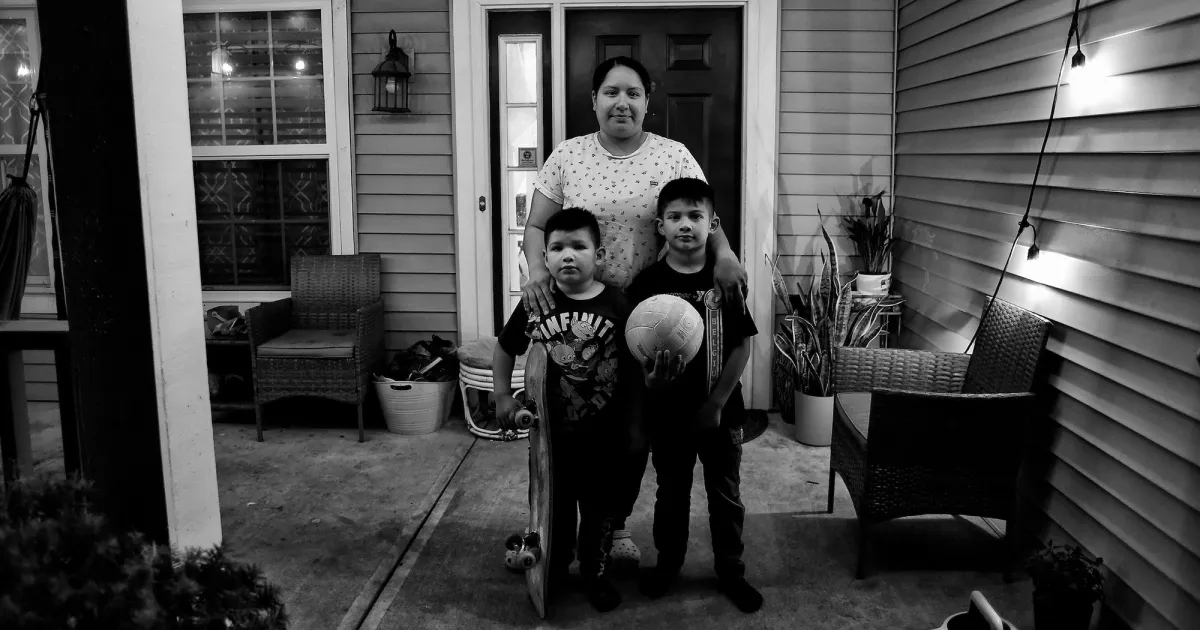
- Share on Facebook
- Share on Twitter
Share on Bluesky- Comments
“Since they grabbed my husband, I don’t know if I should be packing my stuff, trying to sell my house—or should I just keep on waiting?” Joanna says. It’s a Thursday night in mid-May. We’re sitting in her home on the west side of Indianapolis. Her forty-year-old husband, Manuel, has been detained by ICE at a county jail in Indiana for the past two months. Joanna’s two boys miss their father. But being boys, they find their distractions and play around while we talk.
She tells me most people outside the immigrant community in Indiana don’t see what’s happening. “But we see it everywhere,” she says. “It’s all the time. It’s every day. It’s everywhere. Eastside, Westside, Hamilton County. We just know.”
She shares stories of relatives and other families she knows in Indianapolis who have been ripped apart by ICE. Of US-born children now living with relatives. Of women who have sold everything, moving from couch to couch, afraid to go to homeless shelters for fear of exposing their status. She’s lost count. “It’s hundreds. It is not ten. It’s hundreds,” she says. “Sometimes I just don’t want to answer the phone because I need to deal with my own mental space.”
Joanna and her two young sons are US-born citizens. She comes from a multi-generational Latino American family. Manuel was born in Honduras. Indiana has been his home for over fifteen years. He owns a successful roofing business that employs several people. He’s a mentor and leader to them and others in the community. Joanna earned a degree in psychology from the University of Washington. They started a family. They work hard, pay taxes, own their home, have two cars. Their children attend the local elementary school. They volunteer and are active members of their church and their community. Manuel was in the final stages of obtaining permanent residency when ICE “took” him. Their family is one of tens of thousands of mixed-status households in Indiana.
“The new administration thinks, We’re going to just deport everybody and get everybody out of here,” Joanna says. “But there’s not an understanding of how our communities have been here for so many generations, that we are the American community already.”
An oversized cardboard shipping box sits in the corner. It’s overflowing with clothes and other essentials. Over the years, Joanna and Manuel have sent many boxes like this to Honduras to help struggling and less fortunate families. Recently, they’ve sent boxes to help families who have been deported. But this box is very different.
“That box right there,” she says, “That’s filled with our stuff. It’s the first box I’ve filled that has our belongings in it. It’s my emergency box. My family’s box. Because I don’t know if we need to leave or not.”
In less than eighteen months, Indiana has emerged as one of the Trump administration’s most faithful and obliging accomplices in the assault, detention and deportation of immigrants in the country.
One week after Trump’s inauguration, Indiana Gov. Mike Braun issued an executive order to “fully cooperate with these Federal immigration policies to the extent permitted by law.” Earlier this year, Republican state lawmakers pushed through the so-called FAIRNESS Act, which requires all local law enforcement and jails to honor ICE detainers; prohibits ‘sanctuary’ policies; mandates colleges, universities and government bodies to cooperate with ICE, and empowers Indiana’s Attorney General to sue and financially punish those who do not comply. One of the most hardline such laws in the country, it was celebrated by conservatives, including the America First Policy Institute, which said the law “places Indiana at the forefront of state immigration enforcement.”
Andranik
Andranik, a 39-year-old Armenian immigrant born in Uzbekistan, has lived in the US since he was thirteen. He had already spent two years in ICE detention before being transferred to Indiana on December 30, 2025. He spent five months detained by ICE at Miami Correctional Facility. While in the prison he suffered a head injury during a life-threatening seizure. Andranik said he was then pepper sprayed by guards while locked in his cell, handcuffed and moved to another building for no reason.
Read more “I’m Ashamed of My Country”: Biddeford, Maine Locals Grieve Neighbor Killed by ICE
“Miami Correctional Facility, it was huge. They just let you do whatever you want to do over there. They didn’t care about nothing. You can basically kill each other.”
From her home in rural central Indiana, a 35-year-old woman holds her mobile phone and meets with her husband during a video call while he’s in ICE detention. He’s been detained by ICE for almost two months. She was brought to the US from Mexico as a young child. Her 34-year-old husband was born in El Salvador and has lived in the US since he was thirteen. Their children are US citizens. He’s owned a construction company, and did work for Habitat for Humanity to build homes for those in need in Indiana. Local police arrested him for driving without a license. He was transferred into ICE custody and moved to a detention center in Kentucky.
“I hope they know that you’re not hurting the adults,” she said after her video call. “Trust me. I know any adult can go through the pain that I’ve been through. But the damage that’s done to the kids is something you cannot take back.”
Two weeks after our meeting, her husband was released from detention.
When lawmakers in neighboring Illinois banned immigration detention throughout their state, the Clay County Jail seized on the opportunity and approved a $25 million expansion. Today the jail detains an average of 255 immigrants per day.
Open records requests reveal that the jail has earned nearly $12 million in revenue since January 2025 for services directly related to ICE detention. Eighty-three percent of immigrants detained in the jail have no criminal record.
Clay County Jail
This 31-year-old man was brought to the US with his family when he was five years old. Everyone in his family has legal status. His siblings are US-born citizens. He should have received legal permanent residency in 2013, but it took years for his status to be adjusted, so he remained undocumented. In 2017, he was detained by ICE, but a judge approved a bond for his release. He spent more than eight years on bond waiting for his status to be adjusted. On October 2, 2025, during ICE’s ‘Midway Blitz’ operation in Chicago, ICE agents arrested him while he was standing on the sidewalk holding an advertising sign for a furniture store and detained him for eight months at the Clay County Jail while he fought his case.
“Being stuck in this facility usually breaks a person,” he said during a video call. “So I try not to make too [many] calls to my family and loved ones, like compared to other people, because I know that it hurts me more than it helps me, because I’m stuck here.”
Ten minutes before our second call, he found out he was going to be released.
Corydon
The town of Corydon in southeastern Indiana has a population of 3,150. In September 2025, the Corydon Police Department signed a 287(g) agreement with ICE. Leaked documents reveal how 280 law enforcement agencies, including three in Indiana, have received or stand to receive a share of over $250 million in funding as a direct result of 287(g) agreements. The Corydon Police Department has already received $130,015, and is set to receive an additional $846,350 from DHS for salaries and incentives.
Corydon Police Chief Matt Kitterman contends that the 287(g) funding provides valuable training for his officers as well as resources for procuring new equipment and upgrading old equipment, such as outdated body armor. The Corydon Police Department has only nine officers and no jail.
“I have represented people in different courts, in different states, but nothing like the Indianapolis court,” an Indianapolis-based immigration lawyer told me. “I cannot believe what is happening. It’s unbelievable the level of impunity that we are observing. In my mind, it’s like, ‘God, please give me strength to handle what I know is about to happen in this courtroom’. It’s like walking into a prison. You’re treated like you are in prison when you’re there.”
The lawyer is one of four immigration attorneys I’ve spoken with who have filed formal complaints against two immigration judges in the Indianapolis court.
“Courage is doing something that you’re afraid to do, but doing it anyway, right?” a mother and resident of Carmel told me. “I think there’s a lot of people of privilege here who have been given privileges in this system; who have never had to fight against it because we’ve always benefited from it. What’s happening to immigrants is also the alarm bells of eventually what’s going to come for everybody else if you dare to speak out.”
Read more Meet the Multi-Millionaire Pro-Hamas Activist Who Was Arrested in Spain