 By admin
- Share on Facebook
- Share on Twitter
- Share on Bluesky
- Comments
In December 2022, a 20-year-old California woman loaned most of her savings to a venture calling itself Lost Basin Holdings. In theory, the $25,000 loan from the young conservative, who asked to remain anonymous, would be used to develop remote land in northwestern Arizona. But when the loan came due in late 2024, she got nothing back.
Read more James Talarico’s Campaign Is a Messaging Machine. I Watched How It Runs.
The company’s founder, Robert McDowell, tried to reassure her. His company, he wrote in a December 2024 text, was “actively looking” for new investors so he could repay her. She asked McDowell, who court records show has been accused of fraud on multiple occasions as part of prior business dealings, about her money roughly a dozen times last year. In March 2025, he informed her, “We have new investors coming on board to raise $20M and buy up all our Notes.”
That is the same amount Arizona Land Reserve, a real estate development venture McDowell co-founded in January 2025, is seeking to raise by telling investors it aims to provide a “constant 20% annual return for the next 20 years.” What makes Arizona Land Reserve unique is its deep ties to David Flippo, a scandal-plagued Republican in an unexpectedly close race for Congress in northern Nevada. The company is Flippo’s largest identifiable asset, according to an unofficial financial disclosure his campaign provided to the Nevada Independent. He values his stake at between $1 million and $5 million.
Flippo’s ties to the company appear to extend beyond those of a typical passive investor. A person pitched on Arizona Land Reserve, who requested anonymity, told me Flippo was present for all of the investment meetings they attended. When the person asked Flippo if he could advise them on the deal, the source said the candidate declined, citing a conflict of interest. A text message I reviewed shows Stephen Tuminello, Arizona Land Reserve’s other co-founder, stating he has a “professional and business relationship with David Flippo.”
Flippo, in turn, has benefited from hundreds of thousands of dollars in political donations from Arizona Land Reserve and people in the company’s orbit. Taken together, it suggests Flippo—a retired Air Force officer and licensed financial adviser—may have used his credentials to help provide an air of legitimacy to a dubious company that spent lavishly on his behalf.
Flippo, McDowell, and Tuminello did not respond to detailed questions and repeated requests for comment for this article and a previous Mother Jones article about Arizona Land Reserve’s connection to Flippo. I initially reached out to Flippo’s campaign about his finances on September 14. The campaign has not responded to those inquiries.
Reached by phone on Wednesday, Rory McShane, Flippo’s main campaign consultant, said he did not have time to discuss my request for comment about Arizona Land Reserve. He asked that I send questions via email. McShane has not responded to those questions, which I initially sent to him and Flippo’s campaign on Friday.
Arizona Land Reserve says it is seeking to build Valle Privado, a “1st class fly-in community catering to the desires of Luxury Home & Ranch Owners in Arizona that prefer to use private aviation.” The raw land is miles from paved roads, according to county maps and land records. Some of the nearest towns are a former mining camp called Chloride, with about 75 residents, and Santa Claus, a Christmas-themed ghost town that was torn down in 2022.
To meet its target of “constant” 20 percent annual returns, Arizona Land Reserve has said it plans to acquire 3,000 apartments in central and midwestern states with $14 million in capital. It claims it will then use the rent money to fund development of the Arizona land it purchased with $4.8 million of debt last year. Mark Stapp, an expert in Arizona real estate development, put the chances of acquiring thousands of apartments for that amount at between “slim and none.” Overall, Stapp said, the project’s “feasibility is zero.”
Arizona Land Reserve is seeking to raise $20 million from investors in exchange for a 20 percent equity stake in the company, which implies a total valuation of $100 million. Stapp, who spoke to me independent of his role as the director of a real estate development program at an Arizona university, called that “insanity.” He added, “You’re not generating $100 million out of that project. You’re just not.” (I have found no evidence of Arizona Land Reserve buying apartments or filing any permits related to developing the main site.)
Bruce Dubinsky, a forensic accountant who testified on behalf of the Justice Department in acase against employees of Bernie Madoff, said via email that “20% constant returns are a huge red flag.” He added, “Madoff didn’t even promise constant returns that high.”
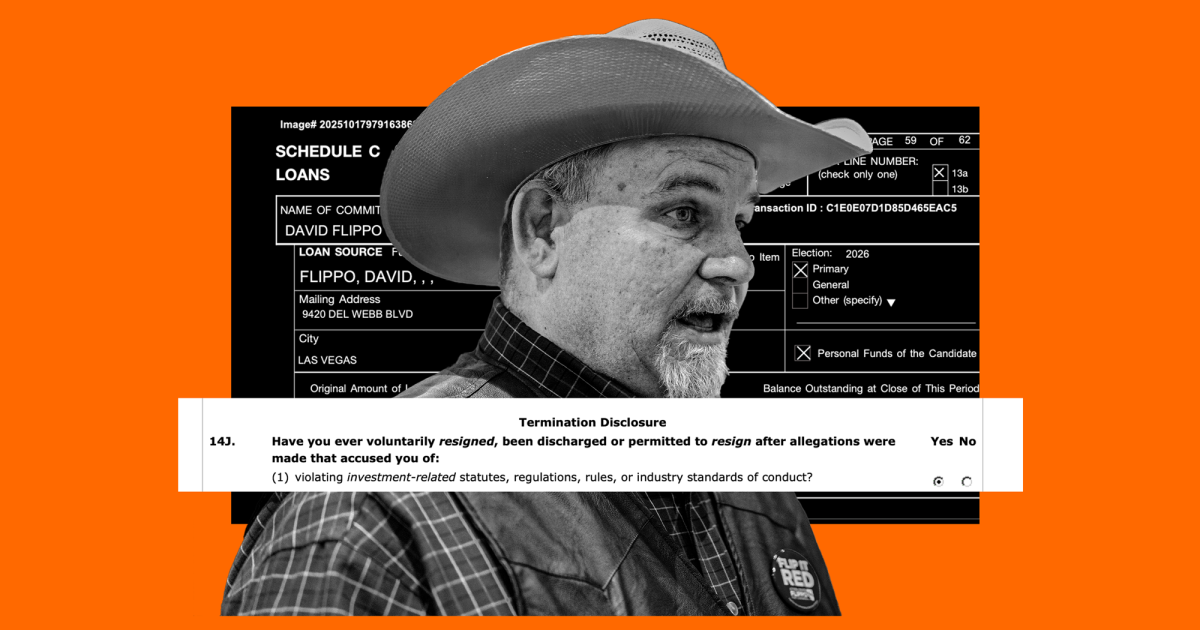
Flippo, who first ran for Congress in 2024, has still not filed an official financial disclosure, even though he has been legally required to do so on an annual basis since 2023. Meanwhile, he has reported putting more than $2.5 million of his own money into his campaigns, despite having no apparent source of such wealth. Flippo has also not said whether his major stake in Arizona Land Reserve reflects money he invested or equity received in exchange for services on its behalf.
Bob Seale, who once served as the chairman of the Nevada Republican Party, submitted a complaint to the Federal Election Commission this week about the questions surrounding Flippo’s finances and campaign fundraising. The complaint draws on previous reporting from Mother Jones about Arizona Land Reserve. It also mentions a person listed as a major donor to Flippo’s campaign who told me they did not make the contribution attributed to them. After drawing parallels between Flippo and disgraced former Rep. George Santos, Seale wrote, “Where there is once again smoke, there might well again be fire.”
Flippo has also faced blowback related to false claims that he earned a Bronze Star with valor, when he actually received a standard Bronze Star. Mark Amodei, the retiring Republican congressman Flippo is running to replace, has now said he didn’t vote for his party’s nominee during early voting. When we spoke on Monday, Amodei reiterated his belief that Flippo is a “fraud” in light of the misrepresentations about Flippo’s military record and the questions surrounding the candidate’s personal and campaign finances.
“Where is that [money] from?” Amodei asked about the self-funding Flippo has reported. “Do you have any confidence on the non-answers? Or just plain ignoring the question: Well, who’s paying for this guy’s ‘personal loans’ to his campaign? That’s why I use the word fraud.”
To raise funds, Arizona Land Reserve’s co-founders have courted fellow conservatives, according to David Shapiro, the Las Vegas lender who sold the company its land and holds the debt on the heavily leveraged property. A second person pitched on an investment in Arizona Land Reserve also said Tuminello was targeting people at events in Nevada popular with Republicans. An ad for Patriot View, the name for a separate set of companies McDowell used to promote Lost Basin’s lots, shows the two men pursuing a similar strategy for that venture. In an advertisement in a conservative publication, they marketed the lots as “Prepper Ready.” The tagline of their project was “saving your money from the banks.” A large number of the people they persuaded to invest in that project were women in their seventies or eighties, public records show.
Flippo has known McDowell and Tuminello since at least May 2024, when the two men attended a fundraiser for his first congressional campaign. That month, Tuminello also paid Flippo’s wife on behalf of himself and McDowell in connection with a Las Vegas gala, a public Venmo record shows. Later in 2024, show Flippo was fired from his job as a financial adviser for an offense related to “bearer bonds,” a largely obsolete financial product known for its use in money laundering and other illicit activities. (“I wasn’t fined for anything,” Flippo has said. “I didn’t lose any licenses.”)
Less than three weeks after Flippo was fired, a deed of trust filed in Mohave County listed his older brother Stephen Flippo as the lender on a more than $200,000 note to Lost Basin—the same company that owed the young investor. In January 2025, the month Arizona Land Reserve was formed, a second deed of trust named Stephen Flippo as the lender on a $136,000 note. On paper, $340,000 was secured by lots valued by the county at about $30,000 combined. The full picture was even more concerning. Shapiro, whose company also sold Lost Basin its land and loaned it $280,000 to execute the deal, told me earlier this month that he holds the senior lien on Lost Basin’s land, meaning Stephen Flippo’s loans could have been wiped out in the event of financial distress. (Stephen Flippo did not respond to requests for comment.)
That was true for other Lost Basin investors—including the young conservative, who did not know Shapiro was first in line to be paid back until we spoke. As with other investors, the land that theoretically secured her loan is assessed by Mohave County at a fraction of the capital she provided.
Shapiro said that McDowell has not yet paid off the $280,000 loan the Las Vegas lender’s company gave to Lost Basin in 2022. Shapiro added that he increased the interest rate from 6 percent to 12 percent after the original loan was not paid off in time. (He said McDowell remains current on his payments to him.)
Read more A Solution to America’s Aluminum Crunch Is Hiding in Our Landfills
McDowell has a record of bad debts and business failures. Two of his earlier ventures filed for bankruptcy in federal court. In one of those cases he was called a “con” by a man who did business with him, according to court records. In an earlier court case, he and his business partners in a gold mining venture called Rock Cabin Mining were accused of operating a “pyramid promotional scheme,” according to Arizona court records. The plaintiff, George Rhoads, said he never received the money awarded to his business after the gold-mining company was found liable for breach of contract. By 2019, after Rock Cabin Mining filed for bankruptcy, court records show that the the value of his claim stood at more than $99,000.
With Lost Basin, Mohave County records show McDowell’s companies paid off prior lenders just as Stephen Flippo’s transactions were recorded—reminiscent of how McDowell told the young conservative investor about using new money to pay off old debts. Dubinsky, who has more than four decades of experience as a forensic accountant, reacted strongly to McDowell’s efforts to find money from new investors to satisfy a prior debt. “If he needs new investor money to repay existing loans, that suggests he lacks sufficient cash to meet his obligations,” Dubinsky said via email. “That dependence on fresh investor capital is a major red flag.”
In May 2025, Flippo, McDowell, and Tuminello appeared together at a Nevada Republican luncheon. The following month, Arizona Land Reserve made a $50,000 donation to the Nevada Republican Party. The party’s chairman went on to help push for Donald Trump’s endorsement of Flippo in the primary, according to a conservative blogger who wrote about the race. And he took the unusual step of endorsing Flippo before the Republican primary. (The Nevada GOP did not respond to a previous request for comment.)
The donation to the Nevada GOP came as Arizona Land Reserve’s fortunes improved, according to a text message McDowell sent the young conservative on the day the contribution was made. “We’ve gotten commitments to fund from 3 people so we’re waiting for their transfers,” McDowell wrote, adding that it was “all retirement money.”
Later in 2025, Flippo was featured in photographs of the only two events that Arizona Land Reserve has posted images of on its Facebook page. His apparent ties to the company came with substantial rewards. In the second half of 2025, people affiliated with the company or its founders donated roughly $70,000 to his campaign—about a third of what Flippo raised from outside donors during that period.
In January 2026, Flippo’s sister Laura Camp gave $60,000 to Turning Point PAC, the campaign spending arm of Turning Point USA. Five days later, Arizona Land Reserve made its first federal political contribution by giving $50,000 to the same group. The following month, Turning Point Action endorsed Flippo. (Camp did not respond to a request for comment.)
In June, Arizona Land Reserve gave another $50,000 to the Freedom Caucus Fund, which had already endorsed Flippo. By August, Freedom Caucus co-founder Jim Jordan was in Reno raising money for Flippo, with McDowell and Tuminello listed among the fundraiser’s co-hosts. The fund has now spent more than $600,000 backing Flippo’s campaign, according to Federal Election Commission records.
The contributions from Arizona Land Reserve are notable both because they seemed designed to pave the way for Flippo’s congressional campaign and because the company had no apparent source of funds other than investor capital. According to an SEC filing about the company’s plan to sell investors $20 million in equity in the company, Arizona Land Reserve made its first securities sale on June 9, 2025, one week after the company made its $50,000 contribution to the Nevada GOP.
In the filing, Arizona Land Reserve told the SEC it so far had received $6.8 million from a dozen investors. The filing also stated that McDowell and Tuminello have been paid $100,000, the same amount of capital they reported putting into the company, according to an operating agreement I obtained. Stapp, who has experience developing more than 10,000 lots in master-planned communities, said he often works as an expert witness in cases where investors are trying to recover money. He noted that Arizona Land Reserve sounded like the kind of project where if ever asked he would “opine on the fact that this was just a batshit crazy-ass idea.”
Stapp explained that Arizona Land Reserve would have to build roads and bring water, electricity, and internet to roughly 4,000 acres of raw land. He is working on a 1,000-acre project that he said will require about $43 million in infrastructure. Arizona Land Reserve has announced plans to raise only $20 million and has said it plans to commit $14 million of that to buying apartments in other states.
Most of the money the company has disclosed raising thus far will need to cover obligations the company has already incurred. Shapiro said the company owes him more than $300,000 per year in interest until the $4.8 million principal on the loans from his company comes due in 2030—more than $6 million in total. The company also would need to pay at least $1.3 million per year if it is going to meet its target of 20 percent annual returns for 20 years. Arizona Land Reserve’s first payments to investors were supposed to go out last month, according to a 2025 company press release. Flippo, McDowell, and Tuminello did not respond to questions about whether those payments were made.
The young conservative investor in McDowell and Tuminello’s Lost Basin said she and her fiancé, who works in conservative politics, eventually turned to a ruse to get her money back: She told McDowell her fiancé was considering investing but wanted to see her loan repaid first.
In early 2026, more than a year after the loan came due, McDowell repaid the young conservative and signed the text with his Arizona Land Reserve email address.In an email to the fiancé about his new venture, McDowell asked: “Are you someone with private funds to put to work for 5 years to 2x your amount?”
The fiancé concluded the investment opportunity was too good to be true. Others proved more willing to give Arizona Land Reserve money. After all, a financial adviser turned conservative congressional candidate was now involved.