 By admin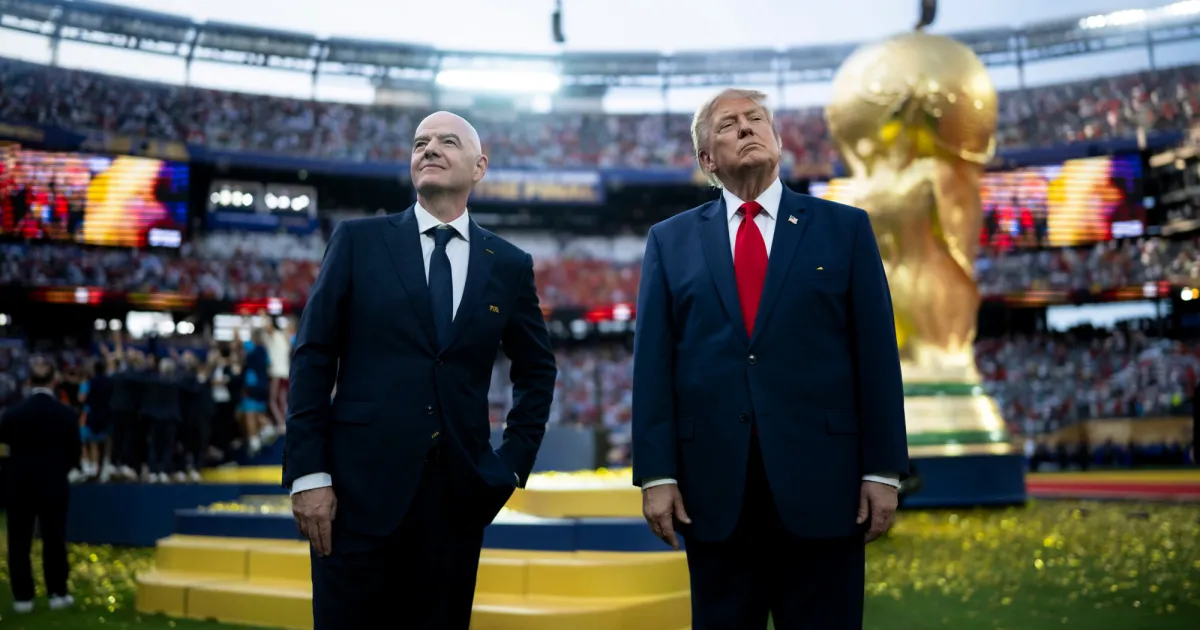
For a long time, Gianni Infantino, the ubiquitous president of FIFA, and Jared Kushner, the businessman and Middle East peace envoy, have seemed inseparable. When the US was awarded a joint bid to host this year’s men’s World Cup, all the way back in 2018, Jared was quick to take credit. It was Jared who arranged Infantino’s first meeting with Trump, at the White House in 2018, where the president flashed a red card at the assembled members of the press. They have had dinner together on the exclusive island in South Florida where President Donald Trump’s son-in-law and his wife, Ivanka, now live. Infantino invited Kushner and his family to participate in the official draw for the 2025 Club World Cup and they currently serve together on Board of Peace. Kushner, according to New York Magazine, has done so many favors for the head of FIFA that he calls himself an “unpaid intern.” But when Infantino had a plan to sell a stake in the world’s game to private equity…well, he went to Josh.
Read more Democrats Call For Ethics Investigation into Congressman Max Miller
Infantino, with help from JP Morgan, is proposing to sell an up-to-20-percent stake in FIFA’s marketing and events business to a “geographically-diversified investor group” of investors helmed by Thrive Capital, the investment shop run by Jared’s younger brother, Josh Kushner. Under the proposal, Thrive and its partners would raise $4.2 billion and FIFA’s 211 member nations would each walk away with a onetime $40 million payday. As it happens, those 211 associations are also the ones who are supposed to vote on this proposal. A simple majority is needed to pass, and without being too coy about it, money has historically proven to be a powerful motivator in FIFA politics. The proposal hit the world of soccer this week like a free kick to the face. The Independent called it “an existential threat to football.” A source told the Telegraph it was a “nuclear bomb.”
The proposal, which Infantino reportedly cooked up without much, if any, consultation from other high-ranking officials, also amounts to a potential golden parachute for the Swiss-Italian bureaucrat. Infantino would be term-limited after his expected re-election next year. According to the The Athletic, the deal would create a new position, analogous to an NFL commissioner, with pay in the range of roughly $60 million a year, and which Infantino would be expected to fill. If that were to happen, Infantino would end up making orders of magnitude more money out of this deal than the soccer federations it purports to enrich.
For the soccer world, this marks a dramatic escalation on two fronts. One of them is something you should care about if you care about soccer, and the other is something you should care about if you care about anything else. The first concerns a conflict between FIFA and its European confederation, UEFA, which is the hegemon of club soccer and also home to most of the world’s top national teams, but which comprises a fraction of FIFA’s voting membership. FIFA and UEFA have clashed in the past over similar cash grabs, and Infantino—despite hailing from Switzerland—has drawn much of his political support and financial backing from outside the continent. If the plan does fail, it will be because Europe was willing to use its substantial non-voting leverage to blow it up. On Thursday, after a hastily-arranged meeting, UEFA pledged to boycott all FIFA competitions not just until after this proposal is tabled, but until FIFA formally commits to never proposing anything like it again. It is not hyperbole to say it is a showdown over the entire structure of the sport.
But the other conflict goes beyond the game, to some familiar questions about finance and politics and power. This FIFA story resonates not because it has been proposed happening at FIFA but because the thing that is happening at FIFA is happening everywhere—investors swooping in to buy a stake in something that doesn’t feel like it should really be anyone’s to sell.
Not all private investment shops are the same, of course. Some of them are sell-off specialists. Some of them just bleed service-oriented professions and make them progressively worse. Some of them, indeed, inject much-needed capital in the right place at the right time. And some of them embed themselves in a venerable kind of place, in a put-together and normal-sounding way, until you wake up one day and realize it’s becoming the kind of thing it was never meant to be. Aside from the extremely self-interested and not necessarily altruistic suits of Europe, that is the fear above all fears: Inviting private investment into your organization is a recipe for private investment dictating what your organization is and does. Maybe sometimes the result is “better marketing and streaming deals.” But probably it’s more tournaments, more teams, more product. The incentives change. The demands change. And the accumulated century-plus of tradition and joy and sweat equity becomes an asset on someone else’s books.
Read more California Does Medicaid Home Care Well. They’re Being Punished For It.
FIFA has been synonymous with big, dubious deals for a long time, of course. But as I explained in a recent episode of Reveal, Infantino’s FIFA marks a significant departure from the sort of corruption that defined the organization under his predecessor, Sepp Blatter.
In the old system, people handed out literal envelopes of money to people you’ve probably never heard of for TV rights to events you probably didn’t watch. That was a very specific kind of corruption. There was a unique FIFA flair to it—a weird tri-state guy and a Trinidadian member of parliament and a bunch of former players and sportocrats hashing out deals in a literal underground chamber in a $250 million compound in a place in Zurich called “Dividend Hill.” It is the kind of arrangement that could only exist in international soccer, and at a particular point in time, when the cash flows were growing at a rate that exceeded the sport’s capacity to exploit it in an organized and notarized way. On balance, it was not a particularly good way of conducting business and the outcomes were scandalous but you have to admit that sometimes it was also pretty funny.
But FIFA under Infantino has become something different. The scandals aren’t necessarily illegal nor are they happening in secret (even if the planning process for this was). The money is on a different level, and the people who want a piece of it are too. Before there was Josh Kushner and JP Morgan and a stake in the World Cup, there was Saudi Arabia’s Private Investment Fund and SoftBank trying to do the same for the FIFA Club World Cup.
Infantino’s FIFA has crossed the threshold from a sports story involving money and power to a money and power story involving sports, and the scandals of his tenure, while draped in a distinctive soccer-like gloss, have concerned the kinds of mergers and acquisitions that have disrupted seemingly every other sector as well. International soccer is an uniquely prominent front in a familiar battleground: A few rich guys stepping in to extract value in perpetuity from something it didn’t build, in exchange for an extremely unevenly distributed short-term windfall. Europe just might succeed in killing it off this time. But you’ll experience it again soon enough wherever you are.
Read more Covid Truthers Are Claiming Fauci’s Diary Was “Scrubbed”